
Food Security Is an Investment, Not an Expense
Food Security Is an Investment, Not an Expense
In my last reflection, I argued that food security should be understood as community infrastructure. If we accept that idea, another question quickly follows: How do we invest in that infrastructure—and how do we sustain it? For generations, much of our response to hunger has been financed as charity. We raise money, secure grants, collect donations, purchase food, move resources, and respond to need. That work matters. Philanthropy has helped build an extraordinary hunger-relief network across this country, and charitable support will continue to have an important role. But infrastructure requires something more than generosity. It requires sustained investment. And that distinction matters.
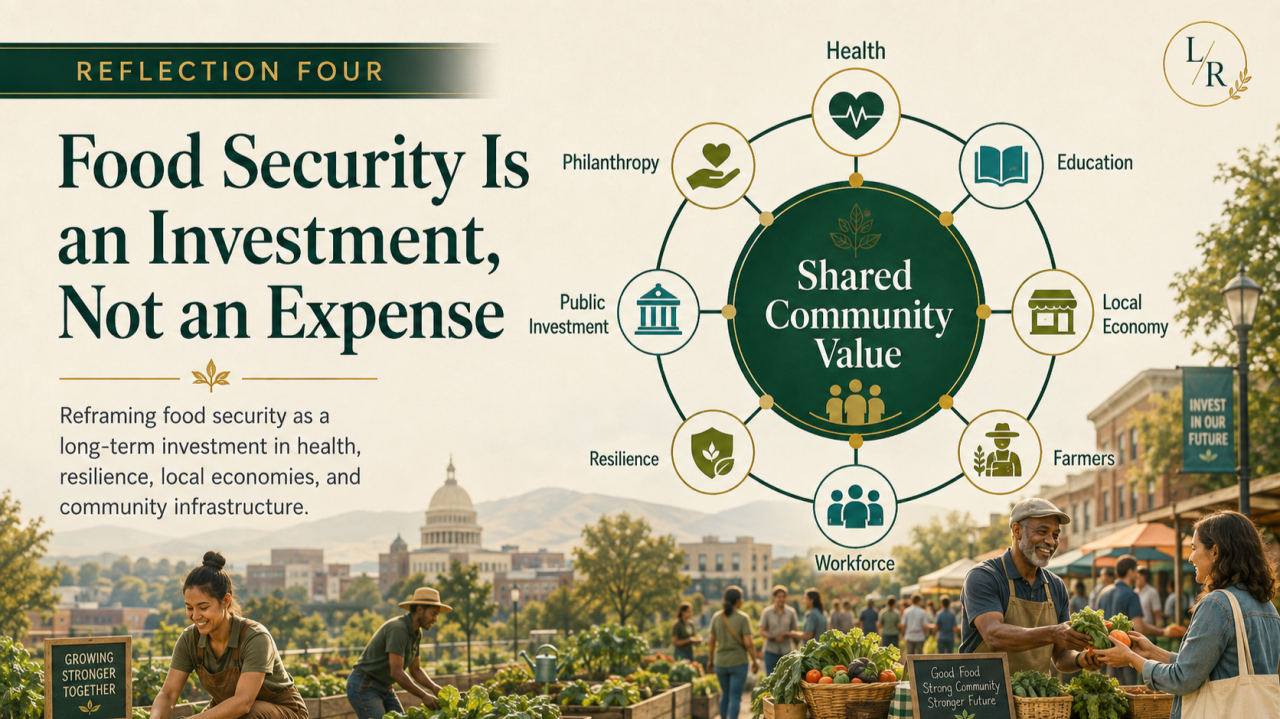
An expense is something we pay for. An investment is something we expect to create value. When we invest in roads, schools, hospitals, transportation, housing, or economic development, we do so because we understand that strong communities need those systems to function and thrive. Food security deserves to be understood through a similar lens. A food-secure child is better positioned to learn. A food-secure senior may be better positioned to manage health and remain independent. A household with reliable access to nutritious food has greater capacity to manage other expenses and withstand disruption.
Local food purchasing can strengthen farmers and local economies. Nutrition and Food is Medicine strategies can connect food access with better health. Workforce pathways across agriculture, culinary services, logistics, transportation, and food systems can create employment and economic mobility. And strong community relationships can make neighborhoods more resilient when crisis comes. The value created by food security does not stop when the meal is eaten. That is what makes it an investment.
One response to Reflection Three helped push my thinking further. Michael Prunka raised the idea of food security as a high-value community investment. His point made me consider something important: if food security creates value across multiple areas of community life, perhaps we should think more broadly about who has a stake in sustaining it. Because the benefits do not belong only to hunger-relief organizations.
Healthcare systems benefit when communities are healthier. Schools benefit when children are prepared to learn. Employers benefit from a healthier and more stable workforce. Farmers benefit from reliable markets. Local economies benefit when resources circulate within communities. Government benefits when households have greater stability and communities have stronger capacity. And communities benefit when neighbors have greater opportunity to contribute, participate, and thrive. If the value is shared, perhaps the responsibility for sustaining the infrastructure should be shared as will.
Beyond a single funding model, philanthropy will remain important. Government programs such as SNAP will remain essential. But neither philanthropy nor public assistance should be expected to carry the entire weight of building a food-secure community.
Peter, responding to the previous reflection, added another dimension that I believe deserves attention. He challenged us to consider how relationships, existing assets, dependable institutional demand, fair markets for farmers, workforce pathways, and a diversified mix of payers might help create a more self-sustaining system. That question is worth sitting with. What would happen if healthcare systems helped finance food interventions that improve health? What if schools, hospitals, universities, businesses, and other large institutions intentionally purchased more food from local and regional producers?
What if workforce-development dollars helped support training and employment within food systems? What if farmers had access to predictable markets rather than relying primarily on temporary programs? What if philanthropy helped provide the early capital necessary to b uild systems that could eventually attract additional sources of investment? And what if communities themselves had greater opportunities for ownership, entrepreneurship, employment, and decision-making within those systems? That begins to look different from a traditional charitable model. It begins to look like an economy.
There is an important caution here. Moving from charity toward investment cannot simply mean finding new ways to finance the same systems. The investment itself should strengthen community capacity. Neighbors should not become passive beneficiaries of a more sophisticated funding model. As I wrote in Reflection Three, neighbors are part of the infrastructure. They are farmers. Workers, entrepreneurs, consumers, volunteers, cargegivers, community leaders, organizers. They are the people with knowledge, relationships, assets, and ideas that institutions do not possess.
Investment in food security should therefore do more than bring resources into a community Whenever possible, it should create opportunities for resources, leadership, ownership, employment, and economic value to remain within that community. That is how an investment begins to build resilience instead of dependency. No one sector can sustain this alone. This does not mean every organization needs to become an economic-development organization, a healthcare provider, a farmer, or a workforce agency. Just as no single organization can build community infrastructure alone, no single funding source can sustain it alone either.
Government has a role. Philanthropy has a role. Healthcare has a role. Business has a role. Education has a role. Agriculture has a role. Community organizations have a role. And neighbors have a role. The opportunity is not for everyone to do the same thing. It is to understand where value is being created, who benefits from that value, and how each contributor might help sustain the system.
For much of my career, our sector has understandably asked: How much will it cost to feed people? That question will always matter. Emergency food assistance will always require resources. There will always be moments when communities need us simply to respond—and respond quickly. But if we are serious about moving beyond the immediate response toward food security, perhaps another question deserves equal attention: What is a food-secure community worth? What is it worth when a child can concentrate in school? When a senior can better manage their health? When a farmer has a reliable market? When a parent has greater household stability. When local food creates local jobs? When healthcare, agriculture, education, business, government, philanthropy, community organizations, and neighbors begin seeing themselves as contributors to the same infrastructure?
Those outcomes are not merely expenses avoided. They represent value created. And perhaps that is the larger shift before us. Feeding people will always be essential. But if food security is truly community infrastructure, then our responsibility is not simply to fund the response. It is to invest in the conditions, relationships, markets, systems, and people that can sustain a healthy, food-secure community for generations to come.
So I am left with this question: If food security creates value across an entire community, how should we share responsibility for investing in—and sustaining—the infrastructure that makes it possible?