
Food Security Is Community Infrastructure
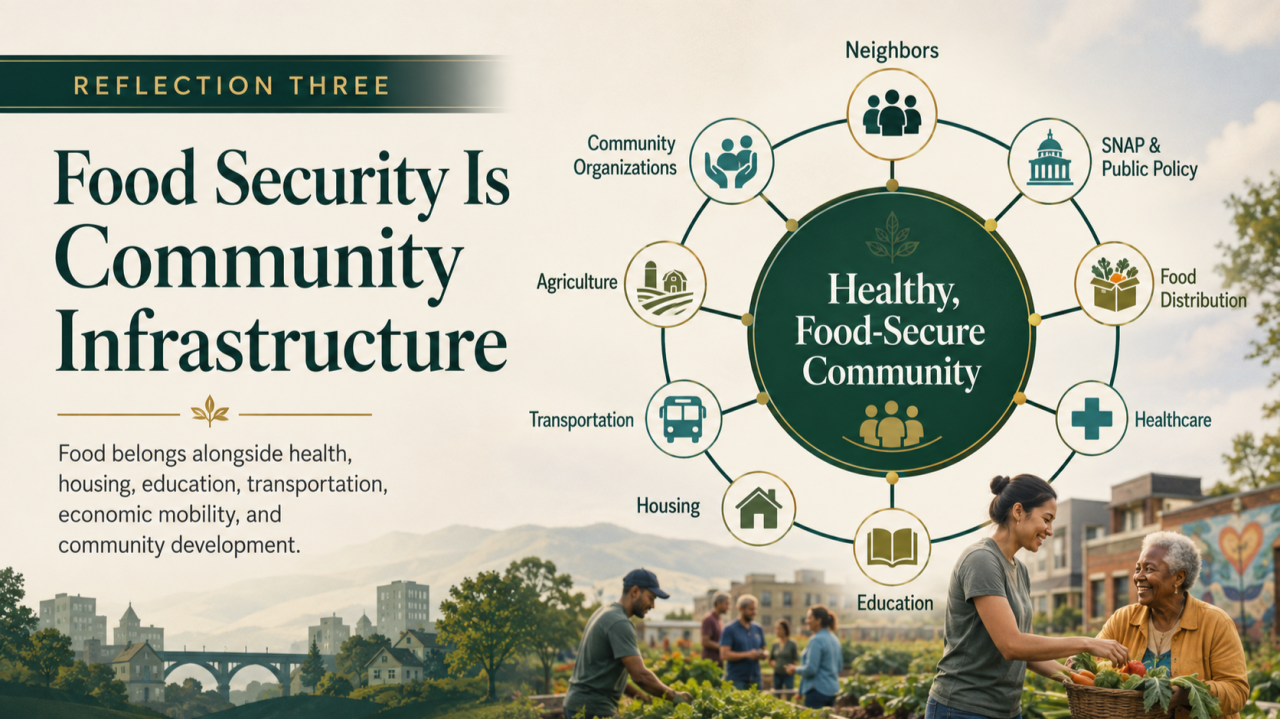
Food Security Is Community Infrastructure
Over the years, I have met families who needed food, but food was rarely the only thing they needed.
A parent was trying to keep the lights on. A senior was balancing groceries against medication. A family had food available but no reliable transportation to reach it. A child received meals at school while the household struggled during weekends and breaks.
We often describe these as separate problems because our institutions are organized into separate sectors. However, experience has taught me that families do not experience their lives that way.
Housing affects food. Transportation affects food. Health affects food. Education, wages, employment, and access to resources all shape whether a household can consistently put nutritious food on the table.
That is why I believe we need to think differently about food security. My thought is that food security is community infrastructure. Because shen we hear the word infrastructure, we often think about roads, bridges, schools, hospitals, and utilities. These are the systems that help communities function. But healthy communities also depend on access to nutritious food, trusted relationships, strong local organizations, economic opportunity, public resources, and the capacity of people to respond when their neighbors face hardship. Food belongs in that conversation.
Infrastructure requires many contributors and if food security is infrastructure, no single organization can build it alone. Government has a role. Programs like SNAP provide resources that help households purchase food through the normal food economy. Public investment is an essential part of food security, and charitable organizations cannot replace it.
Regional food banks have a role. Here in eastern North Carolina, the Food Bank of Central & Eastern North Carolina has built significant capacity to source, warehouse, transport, and distribute food across a large geography. That distribution engine is an important part of our region’s food-security infrastructure. Healthcare, schools, housing, transportation, employers, farmers, philanthropy, faith communities, nonprofits, and local government all bring different resources and capabilities. Most importantly, so do neighbors.
Neighbors are part of the infrastructure, and sometimes we place neighbors at the center of a model and surround them with organizations ready to help. I understand the intention, but even that image can suggest that institutions have the resources and communities simply receive them, however, communities already have resources.
Neighbors bring lived experience, relationships, local knowledge, trust, cultural understanding, creativity, leadership, and informal networks. They often understand the barriers long before institutions do, and they frequently see solutions that become visible only when we are willing to listen. Neighbors are not simply the people for whom community infrastructure is built. They are part of the infrastructure itself.
Perhaps the better picture is a circle. Government brings public resources and policy. Food banks bring sourcing and distribution capacity. Healthcare brings clinical knowledge and connection to patients. Schools bring relationships with children and families. Farmers bring food and agricultural knowledge. Businesses bring jobs and economic opportunity. Community organizations bring trust, relationships, and local presence. Neighbors bring knowledge, leadership, relationships, assets, and lived experience because everyone contributes and no one owns the solution.
This way of thinking has also challenged me to consider the role of organizations like Inter-Faith Food Shuttle and understanding our contribution. If strong food distribution capacity already exists in our region, our value does not have to be measured by how effectively we duplicate it. So we ask, where can the resources and capabilities we have add the greatest value to the larger system?
For us, that increasingly means connecting food with agriculture, nutrition, health, education, food rescue, community engagement, and local capacity. It includes work at the intersection of food and health – often described as Food is Medicine – where nutritious food becomes part of a broader strategy to improve health and well-being. It means listening first, understanding barriers, recognizing existing assets, and working alongside communities to develop solutions that can last.
That does not make food distribution less important. It means recognizing that strong systems work best when different organizations understand what they bring, respect what others bring, and build together rather than trying to do everything themselves.
In my last reflection, I wrote that feeding people is essential, but it is not the finish line.This is part of what I meant. Ending hunger will require food. But it will also require healthy communities with the relationships, resources, opportunity, systems, and resilience necessary to ensure their neighbors do not go hungry. That is bigger than any food bank. Bigger than any government program. Bigger than any nonprofit. And bigger than any one sector.
Perhaps the question before us is no longer simply: How do we get more food to people who need it? Perhapes we also need to ask: what does each of us bring to building a healthy, food-secure community and are we willing to build it together?
What do you think?