
What Does Success Really Look Like?
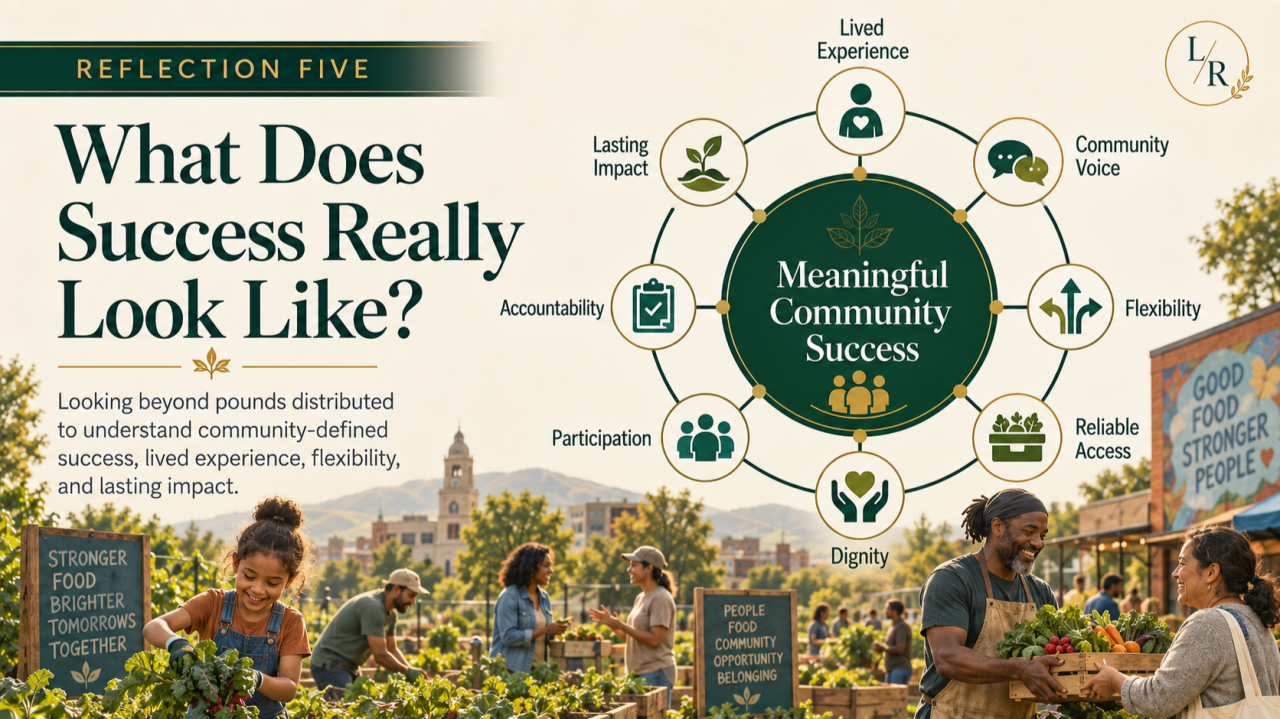
What Does Success Really Look Like?
For more than 25 years, I have worked in food banking. Throughout that time, we have measured success in pounds distributed, meals provided, and people served. Those numbers matter. They help us understand our reach, manage resources, and remain accountable to the people who support our work.
But I have also witnessed something those numbers cannot fully capture. I have seen the relief on a neighbor’s face when they know they can count on a local food system. I have seen the joy in a child’s eyes when they know there is food at home. I have witnessed the excitement of people harvesting vegetables they planted with their own hands just 45 days earlier. And I have seen what happens when neighbors begin to recognize the resources, relationships, and possibilities that already exist within their communities. And that has led me to believe that success cannot be understood solely through what we distribute. We must also understand what changes in the lives of people and the communities they call home.
Imagine a neighborhood where families have faced years of limited food access. Through partnerships, local agriculture, community leadership, and shared resources, a handful of households begin experiencing something different. They have access to fresh food. They know where to turn when challenges arise. They are growing food, sharing knowledge, building relationships, and participating in decisions about their community’s future. The poverty statistics may not have changed. The neighborhood may still be classified as economically disadvantaged. But neighbors may begin describing their community differently: what was once described primarily as a food desert may now be experienced by residents as a growing food oasis. The economic challenges have not necessarily disappeared, nor does that change mean every household has achieved food security. But something meaningful has happened: the community is developing resources, relationships, and confidence to shape its own food future. How do we measure that? And who gets to decide whether it represents success?
For decades, our sector has demonstrated the value of food banking through scale: millions of pounds distributed, millions of meals provided, and thousands of households reached. Those accomplishments matter, especially when communities face immediate and widespread need. But what happens when the greatest impact of an investment is experienced by 20 households rather than 20,000? What if success means a neighborhood has developed a reliable local food system, strengthened community leadership, or removed a barrier that once limited its future?
How do we communicate that value to donors accustomed to seeing impact expressed through large numbers? How do we attract long-term philanthropic investment when meaningful transformation may begin with only a handful of neighbors? A community of 20 households may offer lessons that inform work elsewhere. But its value should not depend solely on whether its experience can be replicated a thousand times. Depth of impact matters, too. We should be able to demonstrate what changed, whether those changes lasted, what resources made them possible, and how the community itself contributed. That is not less accountability. It is a more complete understanding of it. There is another question I believe we need to examine: how much flexibility do organizations actually have to respond to what they learn? Imagine receiving a grant to provide a specific number of meals, establish a certain number of gardens, or deliver a predetermined number of workshops. Those commitments matter. Funders deserve accountability, and organizations have a responsibility to deliver on the promises they make. But what happens when neighbors tell us they need something different? What if transportation, rather than food availability, is their greatest barrier? What if a community already has food access but needs support developing a reliable local system? What if the most meaningful opportunity emerges halfway through a grant period? Do we (you) have the flexibility to respond to what we are learning, or are we required to continue delivering what we originally promised?
I believe accountability and adaptability can coexist. We should be clear about goals, responsible with resources, and transparent about results. We should also recognize that communities are not static and meaningful change rarely follows a perfectly predictable path. Perhaps the issue is not that we rely too heavily on data. Perhaps it is that we sometimes allow predetermined activities to become more important than the outcomes we are trying to achieve. Data should help us understand whether we are making a difference—not prevent us from responding when we discover a better way.
In my previous reflections, I challenged the idea that neighbors are simply recipients of resources. They are contributors to the infrastructure itself. That principle must also apply to how we measure success. Organizations have responsibilities to their boards, donors, and partners. But neighbors have a perspective that no dashboard can replace. They can tell us whether food access has become more reliable, whether solutions reflect their needs and cultures, whether they have meaningful opportunities to contribute, and whether the systems being built are ones they can depend on. That does not mean we abandon quantitative measures or assume that positive feelings alone establish food security. A neighbor can feel grateful for emergency assistance while still worrying about next week’s meals. A child can enjoy harvesting vegetables while their household continues to face economic challenges. The goal is not to replace numbers with stories. It is to bring numbers, lived experience, and community-defined outcomes together to understand the fuller picture.
In traditional service models, organizational growth is often associated with serving more people, distributing more food, and expanding programs. Sometimes that growth is absolutely necessary. But what if a community begins needing less emergency assistance because its own capacity has grown? What if neighbors have built stronger local food networks, developed reliable partnerships, expanded economic opportunity, or gained greater control over the resources affecting their lives? Would we recognize that as success? Would our funding models reward it? Would our dashboards capture it?
I believe we should. Not because emergency assistance has become less important, but because the ultimate goal is not to create communities that depend indefinitely on our organizations. It is to help build communities with the capacity, relationships, resources, and resilience to ensure their neighbors do not go hungry.
Pounds distributed, meals provided, and responsible stewardship will continue to matter. So will a child’s confidence that food is waiting at home; a neighbor’s ability to access nutritious food with dignity; the excitement of growing and harvesting something; and the strength of relationships that make a community more resilient. These experiences will not always fit neatly into a spreadsheet. But they can inform meaningful measures of food access, stability, participation, and lasting community capacity.
Perhaps the next evolution of our work is not simply developing better ways to count what we do. Perhaps it is developing a shared understanding of success—one that combines data, lived experience, accountability, and the flexibility to respond as communities change. Because the greatest measure of our success may not be how much more food a community receives, but how much more capable that community becomes of shaping its own future.
If you work in a nonprofit, how are you defining success? Do your resources and funding commitments give you the flexibility to respond when your community identifies a different need? If you are a funder, how do you balance accountability with the freedom organizations need to learn, adapt, and respond?] And if you are a neighbor or community leader, what changes have you experienced that our traditional measurements may be missing?
I would genuinely value your perspective.
What are we measuring well, what are we missing, and what might we need to do differently?
Engage! This is how we move the needle!